Free preview your 3 biggest leaks, marked on your own site

Automated CRO audit for online stores & landing pages

Find the leaks between browse and buy.

Paste your store or landing page URL. Cartvane walks it like a visitor on a real phone and desktop browser, then returns a health score and your biggest conversion leaks, marked on screenshots of your own pages.

  • Free preview
  • No credit card
  • No app install
  • Results in minutes

Sample · deathwishcoffee.com

Live scan data

76

/ 100

Solid
Home5
Collection1
Product12
Cart0
Checkout1

open issues

01Name, price and proof above the foldHigh
02Delivery cost and date shown near Add to cartHigh
03Popup stack does not block the first visitHigh

Marked on the real store. Every leak comes with annotated mobile and desktop captures.

Built on the research of

  • CXL / SpeeroResearchXL · PXL
  • Baymard InstituteE-commerce UX benchmarks
  • Nielsen Norman GroupUsability & severity
  • LIFT ModelConversion diagnosis
  • Fogg B=MAPBehaviour model
  • CialdiniInfluence principles

Our methodology: 72 checks, each tied to a published source. Every finding is rated for severity (NN/g), tagged with its LIFT factor and prioritised with a PXL score. Sources are cited, not partners or customers.

Most visitors leave. Few sites know where.

The leaks are rarely dramatic. A price below the first screen, a delivery date nobody can find, a pop-up stack on the first visit. Each one is small; together they decide who checks out.

  • 70.22%

    Average documented cart abandonment rate, across 50 studies.

    Baymard Institute · benchmark

  • 40%

    Of abandoners who weren't just browsing left over extra costs shown too late.

    Baymard Institute · benchmark

  • 62%

    Of mobile product pages rated “mediocre or worse” for UX performance.

    Baymard Institute · benchmark

How it works

No call. No install. A real walk through your site.

  1. 1. Paste the URL

    One field. No account, no app install, no theme access. A store, a landing page or any page of the site works.

  2. 2. We walk it like a visitor

    A real phone-sized browser and a desktop browser walk the path to buy or sign up: home, collection, product, cart and checkout on a store; the hero, calls to action, proof and key pages on a landing page.

  3. 3. You get a ranked fix list

    A health score, your biggest leaks with annotated screenshots of your own pages, and the full report when you want every fix.

  • Mobile 390px + desktop 1366px
  • Online stores · landing pages · SaaS sites
  • Home → Collection → Product → Cart → Checkout
  • Annotated screenshots
  • Never places an order

Inside the report

Not a score. A fix list a consultant would sign.

Open the full sample report

01Your own store

The exact element is marked on mobile and desktop captures.

02Measured

Pixel positions and counts from the page, not adjectives.

03Reasoned

The behaviour it breaks, with the principle behind it.

04Owned

Concrete steps, who does them, and how to test it.

01

Fails · HighProductPXL 11/14Effort ~1hOwner · ThemeJust do itPDP-02

Name, price and proof above the fold
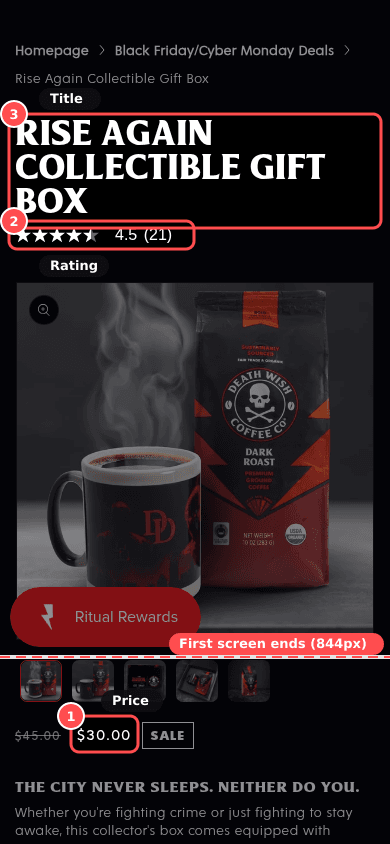
Annotated mobile screenshot
Mobile · 390 × 844
deathwishcoffee.com/products/rise-again-collectible-gift-box
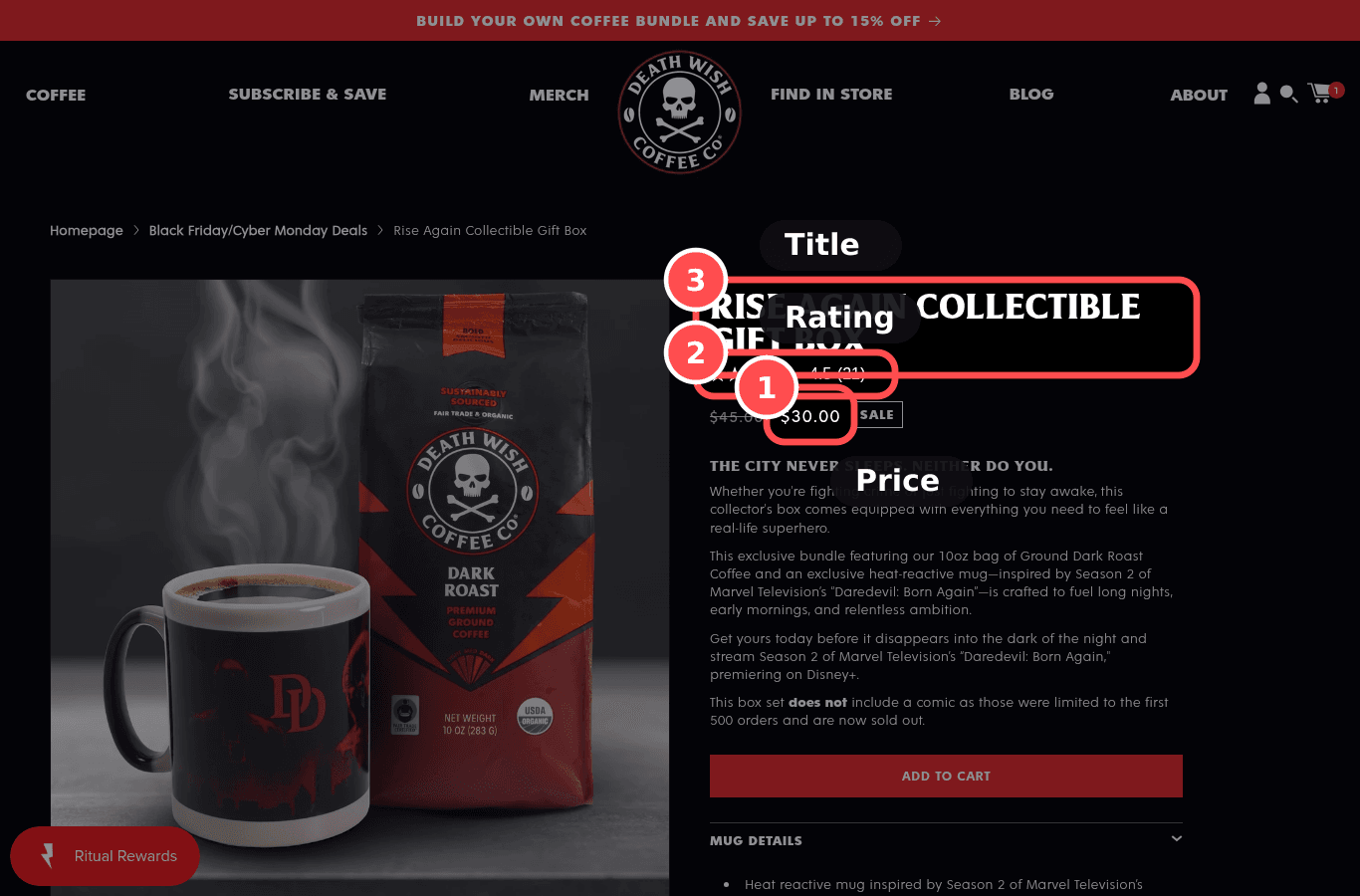
Annotated desktop screenshot
Desktop · 1366 × 900

01The problem

Price ($30.00) starts 909px down, below the 844px first screen. Star rating starts 414px down, inside the first screen.

02Why it costs conversions

Shoppers scan the top-left first; title, price and rating together answer 'what, how much, is it good' in one look.

Principle · F-pattern, social proofLIFT · value proposition / clarityFogg · motivation

03The fix · Theme

  1. 1Show the product name, price and star rating together at the top of the page on mobile, next to the buy button.

04Expected impact

High impact on add-to-cart

If title, price and rating sit together above the fold, then add-to-cart rate will rise, because key decision info is seen first.

mobile 390 · deathwishcoffee.com/products/rise-again-collectible-gift-boxnngroup.comcxl.com

Real finding from a scan of deathwishcoffee.com. Unedited output; benchmarks are labelled as benchmarks.

What we check

72 checks. Ordered by distance to checkout.

Grouped into the steps of the buy path. Each finding carries a principle, a LIFT factor, a PXL score out of 14, an owner and a Shopify Plus flag when the fix needs one. On landing pages and SaaS sites, store-only checks are marked not applicable and left out of the score.

0111 checks

Home

  • Value proposition is clear in 5 seconds
  • First screen offers a path to a product
  • One dominant call to action on the first screen
028 checks

Collection

  • Product cards show price, image and title
  • Filters and sort exist and work on mobile
  • Quick-add handles variants correctly
0320 checks

Product

  • Add to cart visible on the first mobile screen
  • Name, price and proof above the fold
  • Add to cart is visually dominant; buy box is uncluttered
048 checks

Cart

  • Checkout button visible in cart drawer and /cart
  • Edit quantity and remove work
  • Free-shipping bar is honest
0510 checks

Checkout

  • Cart reaches checkout in one tap
  • Guest checkout allowed
  • Express wallets shown first in checkout
067 checks

Speed

  • Mobile LCP on the product page
  • Mobile LCP on home and collection
  • Interaction responsiveness (INP)
078 checks

Trust

  • Policies exist, are plain and linked near buy and footer
  • Real contact options
  • Payment icons match real methods

The research basis

Every finding carries its reason.

A leak without a reason is an opinion. Each card names the behaviour it breaks and the research behind it, so you can argue with it, test it, or hand it to a developer.

UX benchmarks

Baymard Institute

Large-scale e-commerce usability research. Product page, cart and checkout checks follow its guidelines, and benchmarks are quoted as benchmarks.

Prioritisation

CXL / Speero · ResearchXL & PXL

Every finding is bucketed (just do it, test, investigate) and carries a PXL score out of 14, so the list is ranked by evidence, not by volume.

Diagnosis

LIFT Model

Each issue names its primary factor: value proposition, relevance, clarity, urgency, anxiety or distraction.

Behaviour lever

Fogg B=MAP

Behaviour needs motivation, ability and a prompt at the same moment. Each fix says which of the three it restores.

Persuasion

Cialdini

Social proof, authority, scarcity and the rest are cited only where the finding really is about that principle.

Severity

Nielsen Norman Group

Severity weighs frequency, impact and persistence, then maps to High, Med or Low with a one-line reason.

Sources are cited, not partners. Cartvane is independent and not affiliated with or endorsed by these organisations.

Early users

What people are saying after their first scan.

Store owners, marketers and agency leads who ran Cartvane on their own pages. Quoted by name and brand, with their permission.

10 early users and counting

Pasted my PDP and Cartvane flagged three leaks I'd been staring past for months.

Maya EllisonLumen Goods
Quoted with permission
  • Shows exactly where buyers drop off, on screenshots of my own store.

    Daniel ReyesNorthbound Supply
  • Walked into a client call with a prioritised fix list. Looked like a genius.

    Priya NairFifth & Oak
  • The mobile walkthrough caught a sticky add to cart issue my dev missed.

    Tom WalshHarbor Athletic
  • Paid agencies four figures for less insight than this gave me free.

    Sofia MarchettiVela Skincare
  • Health score plus annotated screenshots is the combo I didn't know I needed.

    Aaron BlakeGrove & Co
  • Every recommendation ties to published research, so I actually trust the calls.

    Hana KimDriftwell
  • Sanity checked a landing page before a paid push. CVR moved within the week.

    Marcus HaleRidgeline Gear
  • The on screen leak markers make it obvious even to clients who don't know CRO.

    Elena CostaBloom Theory
  • Paste a URL, get a real audit, no fluff.

    Jordan PierceCedar & Pine

Who's behind it

Built by a CRO practitioner. Not a faceless tool.

Cartvane is built by Saif Ur Rehman, founder of 11.Studio, a Shopify and eCommerce growth and CRO agency in Lahore, with 5+ years and 110+ international projects behind him. Cartvane automates the first pass of a CRO audit so you get it in minutes.

Saif Ur Rehman

Founder, Cartvane · Founder, 11.Studio

years in eCommerce CRO
5+years in eCommerce CRO
international projects
110+international projects

Pricing

Agency-grade depth. Not agency pricing.

Preview

$0per scan

See where you stand before paying anything.

  • Health score and journey map
  • Your 3 biggest leaks, annotated
  • The fix for the #1 leak
  • Count of every other issue found
Scan free
Recommended

Full report

$19once

Every leak, ranked, with the fix. Yours to keep.

  • Every failing and warning check, ranked
  • Mobile + desktop evidence for each
  • Fix steps, owner, effort and PXL score
  • Test hypothesis and research links
  • 30/60/90-day roadmap
  • PDF to share with your developer
Get the full report

Monitor

$29/ month

For teams that ship changes every week.

  • Unlimited re-audits of one site
  • The full report, again, after each fix
  • The $19 report included when you start
Start monitoring

Fewer than 5 issues in a paid report? Ask for a refund within 7 days.

Published agency Shopify audits list at $397–$1,500. That is a human-led, different scope, shown only for reference.

FAQ

Questions worth asking first.

The short version: public pages only, no promises we can't measure, and a refund if the report is thin.

What does Cartvane do?+

Cartvane is an automated conversion (CRO) audit. Paste a URL and it opens your site in a real phone-sized browser and a desktop browser, runs a research-based checklist, and returns a health score plus your biggest conversion leaks marked on screenshots of your own pages, each with the fix.

Does it work on landing pages and SaaS sites, not just stores?+

Yes. When no store is found, Cartvane audits the site as a landing page or content site: first-screen clarity, value proposition, calls to action, trust signals, navigation, speed and mobile. Store-only checks such as cart and checkout are marked not applicable and left out of the score.

What exactly does it scan?+

Public pages only, at 390px mobile and 1366px desktop. On a store that is the buy path: home, a collection, products, the cart and the checkout landing. On a landing page or SaaS site it is the landing page plus the main pages linked from the header and sitemap.

Is it safe to scan my site?+

Yes. Cartvane reads public pages only. On a store it may add an item to its own cart so the cart and checkout landing can be seen. It never fills checkout, places an order, submits a form or tries to get past a bot check.

How much does it cost?+

The preview is free and needs no credit card: a health score, your 3 biggest leaks annotated and the fix for the top one. The full ranked report is $19 once. Monitor is $29 a month for unlimited re-audits of one site. If a paid report lists fewer than 5 issues, ask for a refund within 7 days.

What data do you keep?+

The URL you scan, the audit result and screenshots of public pages. An email is stored only if you ask for the preview by email or check out, and it is never sold. Payments go through Paddle. Write to us to have an audit and its screenshots deleted.

Your site has leaks. Find them before your ad spend does.

  • Free preview
  • No credit card
  • No app install
  • Results in minutes
  • Free preview with your 3 biggest leaks
  • Full ranked report for $19, once
  • Refund if it finds fewer than 5 issues